

Go looking for the scientific evidence on Tong Ren and you will find a thin landscape: one 2009 survey, two prominent skeptic blogs calling the practice voodoo, and practitioner sites explaining things in the language of collective unconscious and quantum biology. For anyone reading carefully, that is not a reassuring set of results.
What follows is the actual state of the evidence: what the one published study shows, what Michael Levin has said publicly and what he hasn’t, and where the honest reading leaves you. I run a Tong Ren practice. Take what follows with that in mind.
The one published study
Tong Ren is a practice developed by Tom Tam in the late 1990s. The peer-reviewed evidence base consists of one published survey: Sullivan et al. (2009), a study of cancer patients attending Tong Ren support groups, conducted under IRB oversight at Dana-Farber / Harvard Cancer Center. It is a cross-sectional, self-report survey of 265 self-selected participants, with no control group, no placebo, no blinding, and no randomization. Participants reported substantial rates of perceived improvement across a range of conditions.
Every one of those descriptors does real work. Cross-sectional means a snapshot, not longitudinal follow-up. Self-selected means the participants were already attending Tong Ren sessions, not a random sample. Self-report means the outcomes were what participants said, not what was independently measured. 265 is a small number for a survey of this shape.
That is a data point. It is not evidence of efficacy in the clinical sense. Anyone who cites Sullivan 2009 without the limitations in the same breath is not handling evidence carefully.
The accurate summary: one survey at a major US cancer center, conducted under research ethics oversight, found that a specific self-selected population reported subjective benefit from attending Tong Ren sessions. The finding warrants more rigorous investigation. It does not substitute for that investigation.
The honest thing to say about the published evidence base is that there is not much of it, that what exists has the shape of early-stage exploratory data rather than confirmation, and that anyone promising you otherwise is selling you something. That includes me, in relation to my own practice.
What Michael Levin has actually said
Michael Levin is the Vannevar Bush Distinguished Professor at Tufts and director of the Allen Discovery Center. His published research is on developmental bioelectricity — pattern memory in planarian flatworms, bioelectric control of tadpole regeneration, voltage-encoded anatomical blueprints. It is actively cited, peer-reviewed, and has spawned an FDA-approved bioelectric medical device pipeline. The research is serious.
Levin has spoken publicly about Tom Tam, most accessibly on The Tim Ferriss Show, episode 849, January 2026. He said he has known Tam since the 1980s, has been treated by Tam personally, and considers what he has observed at Tam’s Boston clinic over decades worth taking seriously.
That is personal testimony from a credentialed scientist about a person and what he has observed. It is spoken under Levin’s own name, on a large public platform, at a professional cost he has presumably calculated. It is not a trivial thing to say.
It is also narrower than it is sometimes made to be. Levin has not publicly endorsed Tong Ren as a modality. He has not proposed a mechanism for how Tong Ren works. He has not published research on Tong Ren. His peer-reviewed publications are on developmental bioelectricity in controlled laboratory systems — not on any applied practice, including the one I run.
Anyone citing Levin’s public comments as validation of Tong Ren is overreading them. What he has said in public is that he knows Tam, that he has been treated by him, and that he considers what he has observed worth serious attention. That is a specific statement about a person. It is not a statement about a modality. The distinction is the whole game.
The mechanism class is real. That is a different claim.
In July 2025 the FDA approved SetPoint Medical’s vagus-nerve stimulation device for rheumatoid arthritis. The approval was based on the RESET-RA trial: 242 patients, double-blind, sham-controlled, published in Nature Medicine. A small implanted electrode delivers calibrated pulses of electrical stimulation to the vagus nerve. The treatment group showed durable reduction in disease activity versus sham. A second company, Boomerang Medical, holds FDA Breakthrough Device Designation for Crohn’s and ulcerative colitis, with a pivotal trial enrolling.
What this establishes: the mechanism class of electrical modulation of a specific neural pathway producing measurable immune effects is real, credentialed, and moving through the standard clinical pipeline.
What it does not establish: that Tong Ren, or any other non-implanted practice, operates through this mechanism class. RESET-RA involves a surgically placed electrode delivering calibrated electrical pulses to a specific nerve. A Tong Ren session involves a practitioner tapping an anatomical model while a client rests in a calm state. These are different things. If the mechanism ends up being relevant to what practitioners observe in Tong Ren sessions, that would be a finding to be demonstrated, not assumed.
I raise SetPoint here because when you are evaluating whether an area is worth any attention at all, “the mechanism class is FDA-approved” is meaningful context. It is not a piece of evidence for any specific non-implanted practice.
Three things that get conflated
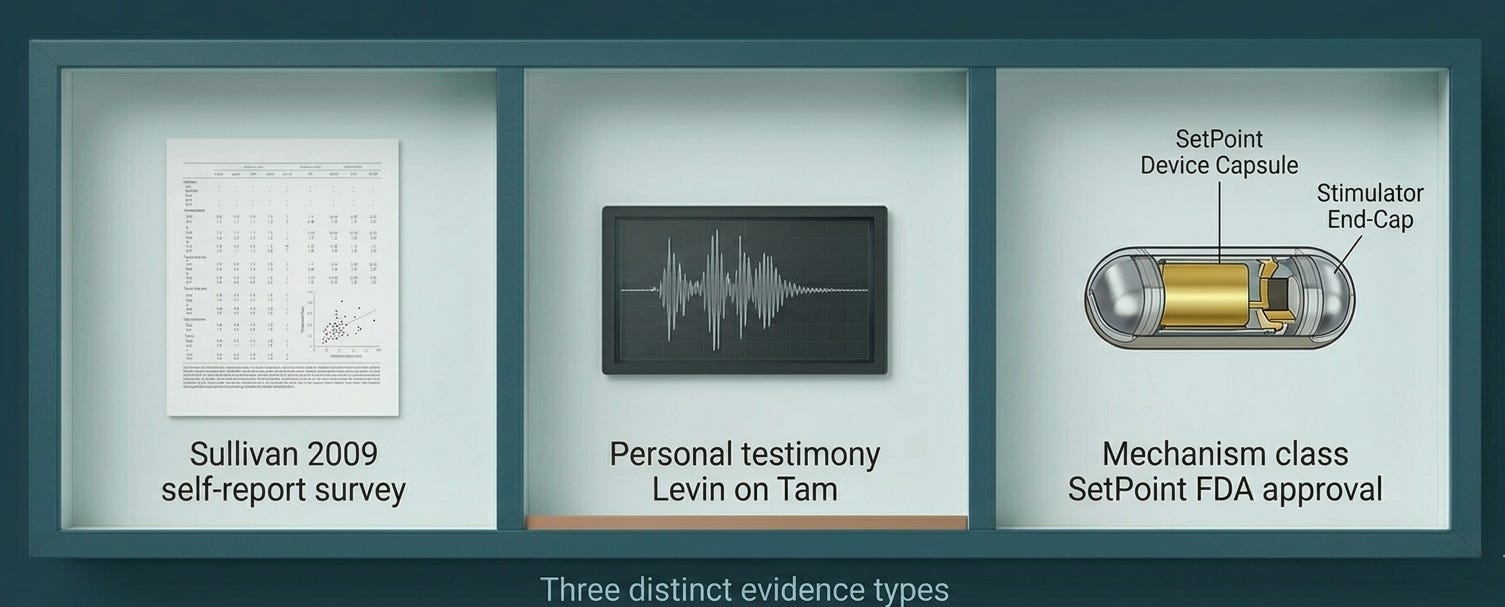
Taken together, what exists is one published survey with serious limitations, personal testimony from a credentialed scientist about a person he knows, and a real but separate mechanism class moving through clinical approval. Those are three different things. A careful reader would not compress them into one.
You do not have to take the practice seriously. You do have to distinguish the three.
What I offer, in the newsletter and in the practice it sits alongside, is not a claim that Tong Ren has been shown to work. It is an application of an attractor-state framework drawn from bioelectric cognition research, used to describe what a practitioner observes in sessions, with the limits of that observation clearly stated. I treat the practice as a bounded experiment on specific clients with specific patterns, tracked over a specific protocol. The mechanism is what the evidence has not answered. I do not claim to have answered it.
The open question
The causal mechanism connecting bioelectric cognition research to Tong Ren observations is unknown. Published research on developmental bioelectricity does not describe, validate, or endorse Tong Ren or any other applied practice. Levin’s public comments are about Tom Tam and what Levin has observed — personal testimony about a person and a clinic, not a public statement about Tong Ren as a modality, not a proposed mechanism, and not a scientific endorsement.
A randomized sham-controlled trial of Tong Ren is not conceptually difficult to design. It is not the state of the evidence today. That matters, and stating it plainly is the minimum the question deserves.
Johanna Farrimond holds degrees in Physics and Electrical Engineering and an MSc in Information Assurance with Honors. Research framework: bioelectricrecovery.com/research
If you found this useful, the most helpful thing you can do is forward it to one person who thinks carefully about evidence.
This newsletter sits alongside a practice translation and a Tong Ren protocol at Bioelectric Recovery. The newsletter is a research translation; the method this site sits alongside is separately described. Attribution boundaries — published research / personal testimony / observed pattern — are maintained between the two.